
SuiteApp · CraftQL
Author NetSuite reports in SuiteQL, checked against your account
CraftQL builds every query against your account's real schema: the tables, the custom fields, and the columns the role that will run it can read.
It reads your live NetSuite account role by role, completes and checks your SQL as you write it, then turns the result into a report your team can run and a tile on the dashboard.
CraftQL is patent-pending technology developed by YTBE, Inc.
Why CraftQL
Three things CraftQL checks in your own account.
A test on a live account A frontier AI model was asked to write a query against a custom record with no schema supplied. It made up all of its field names.
None of its eight field names existed, so the query could not run. On a common standard table the same model got nine out of nine right. We ran the test ourselves on a real account and checked every identifier the model used against the account's verified field catalog.
Product demos
See it running
Each demo plays when you scroll to it. Pause it, step through it, or open it fullscreen.
Every NetSuite table, and which ones your role can actually read
Search every table NetSuite documents, then check one against your own login to see what you can really read. Candidate is a documented possibility; only a live check for your role makes it verified.
An editor that already knows your account
Tables, fields and functions finish themselves as you type, limited to what you are allowed to read, and checked before you ever press Run.
Put a trend on every row
Pick a trend from the column settings and CraftQL writes the query behind it. Your own SQL stays exactly as you wrote it.
Lay the report out by clicking and dragging
Click a column to change how it looks. Drag one onto the page to chart it. Every number you end up with came from the one query you already trust.
Drill from the number to the lines
Open any row to see the detail behind it. The report stays where it is, and the row you came from comes with you.
Know who can run it before you share it
Check the report against every role in your account before you send it, and see who is blocked outright and who would quietly be missing a column.
Ship it as a report, or as a dashboard tile
The same query becomes a report your team can run with ordinary filters, and a tile on the NetSuite dashboard.
Start from a library of ready-made reports
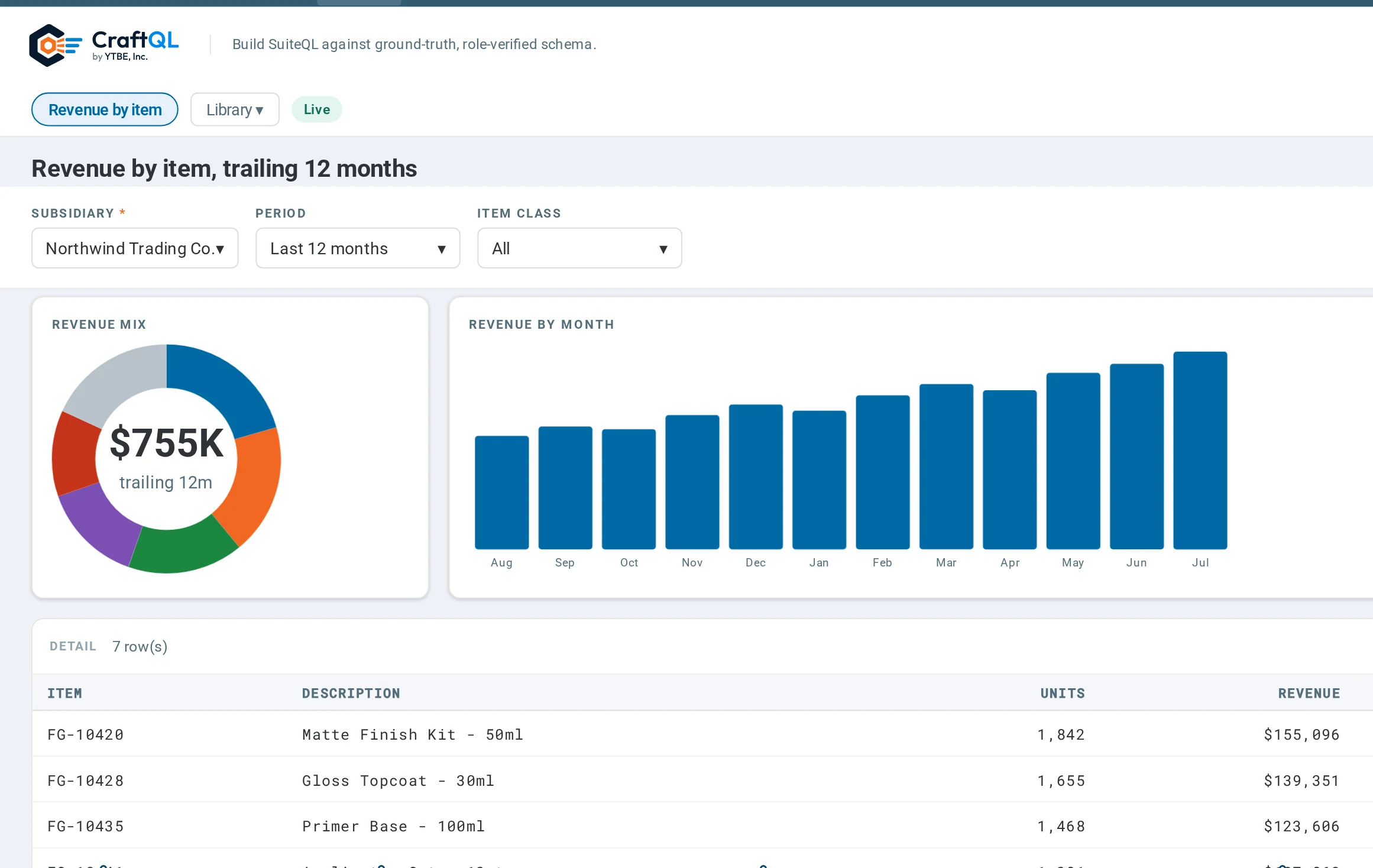
CraftQL arrives with finished reports for Finance, Sales, Customers, Inventory and Purchasing. Open one and it runs, data bars, sparklines and all.
CraftQL questions
The things people ask before the first call.
Does any of my data leave NetSuite?
No. CraftQL is a SuiteApp: it deploys into your own account and runs there. Queries execute under the signed-in user's own role and permissions, so access follows the rules you already set.
What does "verified" actually mean here?
That a field has been confirmed live against your account, for a specific role, rather than read out of documentation. CraftQL also records how recently it checked, so you can tell live ground truth from an aging assumption.
Do I have to write SuiteQL by hand?
You can, and the editor helps: it completes tables, fields and functions as you type and checks the query before you run it. Trends, charts and drilldowns are added by clicking, and your own SQL stays exactly as you wrote it.
What happens to a report once I have built it?
It persists, as a report your team can run with ordinary filters and as a tile on the NetSuite dashboard. It is not a chat answer that disappears when the window closes.
Does CraftQL come with reports?
Yes. It installs with a library of finished reports across Finance, Sales, Customers, Inventory and Purchasing, which you open from the Library and run.
More SuiteApps
Each SuiteApp works on its own. Use one, or several.
See CraftQL on Your Own Data
Let's walk through what this looks like against your NetSuite account.